
Shuttle System Pallet Manufacturer: Export-Ready Solutions for High-Density Storage
2026-10-04
Warehouse managers chasing higher density often hit the same wall: more pallets mean slower access, unless the system is designed to move them intelligently. That’s exactly where shuttle racking changes the game—and why the choice of pallet manufacturer matters more than the specs sheet suggests. Lanyuda builds shuttle system pallets for operations that can’t afford downtime, misalignment, or guesswork. In this post, we unpack what export-ready really means for high-density storage—and what to look for before your next retrofit or new build.
Tailored Pallet Engineering for Automated Shuttle Systems
Pallet design for automated shuttle systems begins with the interface, not the board. Every shuttle model has its own pickup geometry, sensor alignment, and acceleration profile, so standard off-the-shelf pallets often introduce vibration or misalignment. Custom engineering maps the exact contact points, wheel paths, and stop positions to keep the load stable during high-speed lateral moves.
Material selection and reinforcement follow the shuttle's duty cycle rather than a generic load rating. If a system runs 24/7 with rapid direction changes, the pallet needs impact-resistant edges, reinforced corner blocks, and a deck thickness that won't warp under repeated point loading. Overbuilding wastes energy and reduces storage density, so the structure is tuned to the actual forces in play.
Beyond the physical shape, tailored pallets can carry embedded RFID tags, barcode plates, or sensor cutouts that match the shuttle's read points. This turns the pallet into an active part of the inventory loop, allowing the system to verify load presence, orientation, and ID without extra manual steps.
Building for High-Density Warehouse Realities
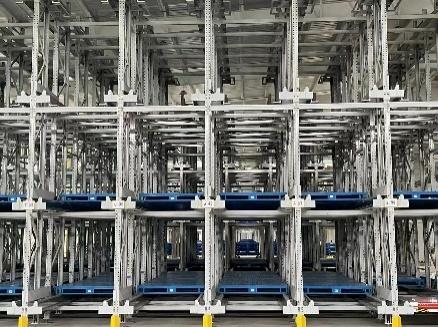
High-density warehouse design starts with the racking, not the walls. Aisles get squeezed to lift-truck turning radii, uprights climb past 30 feet, and every column placement either unlocks storage depth or kills it. Floor flatness tolerances tighten because a 5-millimeter deviation at ground level becomes a serious lean at the top beam. If the slab drifts, rack deflection climbs and pallet flow slows.
Power and data runs need to follow the same plan as the storage layout. Dense facilities pack more pickers, scanners, and chargers into the same footprint, which pushes heat and cabling into spaces originally sized for lighter use. Cooling zones, drop points, and breaker panels should be mapped against rack elevations before the first upright is bolted down. Dock doors and staging areas also deserve more weight in the layout, since a high-density building only works when inbound and outbound flows don't compete for the same aisle.
Export Packaging That Survives Real Shipping Conditions
The route from loading dock to overseas warehouse rarely matches the clean conditions in a lab report. Export cartons get speared by forklift tines, slammed onto conveyor rollers, and stacked inside containers that swing through tropical humidity for weeks. If the packaging isn't built for those ugly moments, the resulting crush damage and moisture stains wipe out profit before a single unit reaches the shelf.
Moisture often does more harm than impact. Standard corrugated board loses a large share of its stacking strength once relative humidity climbs above 60%, and container rain can soak pallets even on a cloudless voyage. That's why silica gel, vapor barriers, and vented pallet wraps belong in the structural plan rather than as afterthoughts. Edge protectors and double-wall corrugate also keep nylon straps from cutting into the load during rough port handling.
Real-world testing means stacking vibration, impact, and compression in the same sequence, because damage accumulates instead of arriving as a single clean failure. A carton can pass a polished drop test and still collapse after ten days at sea under three-high stacking. If it has not been punished the way a freight forwarder will punish it, it is not export-ready.
Material Choices That Extend Pallet Life Cycles
The lifespan of a pallet rarely hinges on a single design decision—it often comes down to what it’s made from. Pressure-treated softwoods, for example, resist fungal decay and insect boring far better than raw pine, but they can warp if kiln-dried improperly. On the other hand, hardwoods like oak or maple hold up under heavy loads and repeated forklift impacts, though their weight drives up fuel costs across a supply chain. Choosing a material isn’t just about initial strength; it’s about predicting how the board will behave after 50 trips through a damp warehouse or a sun-scorched loading dock.
Plastic pallets have carved out a niche precisely because they sidestep many wood-related failures. High-density polyethylene (HDPE) can shrug off moisture, splintering, and most chemical spills, which keeps a pallet in rotation for years instead of months. But not all plastics are equal—recycled-content HDPE may become brittle in cold storage, while reinforced polypropylene offers better impact resistance at a higher price point. The trick is matching the resin to the environment: a freezer facility demands different properties than an outdoor lumber yard.
Then there are the hybrids and engineered options that often get overlooked. Plywood-block pallets combine a plywood deck with solid wood stringers, giving you a smoother surface that reduces product damage while still allowing easy nail repairs. Composite materials—wood fiber blended with resins—can be molded into complex shapes that eliminate weak joints altogether. Even simple choices like using galvanized fasteners instead of standard nails extend life dramatically in corrosive settings. The smartest material strategy isn’t always the most expensive one; it’s the one that accounts for how the pallet will actually be abused, repaired, and eventually retired.
Fitting Seamlessly Into Existing Rack and Shuttle Setups
Integration doesn’t have to mean reworking your entire warehouse layout. The unit is built around common rack and shuttle dimensions, so it drops into place without forcing you to relocate beams, adjust rail spacing, or modify shuttle docking points. Even older installations with minor wear or slight alignment drift tend to accept it cleanly, thanks to a set of floating guide rollers and self-centering pickup arms that compensate for small positional variances.
The control interface speaks the same basic handshake protocols used by most shuttle fleets, which removes the usual headache of commissioning new hardware. There’s no proprietary gateway box or extra layer of middleware to install between the shuttle and your WMS. Once powered, the unit runs a short self-check against the shuttle’s existing sensors, then switches into normal cycle mode without needing a technician to re-teach every pick position.
Maintenance stays just as straightforward. The side panels are tool-free, and key components like the lift motor, chain tensioner, and end-stop buffers sit at accessible heights rather than buried behind structural members. Because the footprint mirrors the shuttle’s own outline, there’s no dead space created along the aisle edge, and the floor anchors use the same bolt pattern as the surrounding rack uprights, keeping the installation consistent and easy to audit.
From Factory Floor to Foreign Port: What Buyers Should Expect
When you commit to an overseas supplier, the journey from the first production run to your receiving dock rarely follows a straight line. Buyers often underestimate how much hands-on coordination happens between the factory floor and the port of departure. You'll find yourself chasing updated packing lists, confirming container loading schedules, and double-checking that the goods match the approved samples — not because suppliers are unreliable, but because small details shift weekly. Expect to allocate real time for video inspections or third-party audits, especially in the final two weeks before shipping.
Once the cargo leaves the factory gate, the next set of variables belongs to logistics rather than manufacturing. Port congestion, customs holds, and last-minute booking changes are common enough that you should treat the original delivery date as a moving target. Smart buyers build a buffer of seven to ten days into their planning and keep a direct line open with their freight forwarder. Instead of asking "when will it arrive," the more useful question is often "what is the current status of the container and what document is holding things up right now."
Finally, remember that clear communication with the factory about your expectations — from labeling and palletization to the exact set of shipping documents — prevents most costly surprises at the foreign port. A buyer who stays quiet until the bill of lading is issued usually pays for that silence in storage fees, demurrage, or a container that sits unclaimed. None of this is glamorous, but it is the real texture of international trade: less about the big order, more about managing the small moving pieces between floor and quay.
FAQ
It goes beyond adding a certification label. For our shuttle systems, export-ready means reinforced steel frames that fit standard 40-foot containers without disassembly, electrical components rated for 380–480V and 50/60Hz, multilingual documentation, and pre-shipment load tests. We also include a full set of spares and a commissioning checklist so the local team can bring the system online quickly.
By eliminating the need for forklift travel inside the storage lanes. A compact shuttle carriage runs on rails inside each lane, allowing pallets to be stored several positions deep while the lift truck stays in the aisle. This can cut aisle space by up to 60 percent and often doubles the pallet capacity in the same footprint.
Cold storage operators, food and beverage distributors, pharmaceutical warehouses, chemical producers, and high-volume e-commerce fulfillment centers. They all share the same challenge: large volumes of uniform pallets, cold or ambient environments, and pressure to maximize cubic space without slowing down retrieval.
Yes. The shuttle controller communicates over standard industrial protocols like Modbus TCP, Ethernet/IP, or Profinet. We provide an API interface and digital I/O mapping so it can receive pick commands, report pallet positions, and sync with conveyor or AS/RS equipment already in the building.
Most of our systems are built for 800×1200mm and 1000×1200mm pallets, but we also support 48×40-inch GMA pallets. Standard shuttle capacity is 1,500kg, with a heavy-duty option up to 2,000kg. We always confirm pallet condition, bottom board orientation, and load overhang before finalizing the lane design.
Every shuttle goes through a 72-hour endurance test, a full load cycle test, and a safety inspection before crating. We use IP54-rated enclosures, cold-forming steel for structural parts, and corrosion-resistant coatings for sea freight. The crates are built with shock indicators and moisture barriers, and we include certified lifting points for safe unloading.
Remote diagnostics come standard: the shuttle logs faults and operating hours, and our engineers can access that data over a secure VPN. We supply a recommended spare parts kit with the first order, offer on-site or video-based training for maintenance teams, and can arrange annual preventive maintenance visits depending on the destination country.
Yes, and that is one of our strongest use cases. We use low-temperature lubricants, heated battery compartments, and cold-rated sensors and cables so the shuttle operates reliably down to -30°C. The rail design also minimizes ice buildup, and we recommend a defrost cycle for the charging area to extend battery life.
Conclusion
Every pallet leaving our facility is engineered around the precise movements of automated shuttle systems—not adapted from a generic warehouse design. Load-bearing zones are reinforced where shuttle arms make contact, and dimensional tolerances stay tight enough to prevent jams in dense racking. Because high-density storage leaves little room for error, we test prototypes under full payload shifts and lateral forces that mimic real retrieval cycles. Material selection then follows the expected life of the pallet: kiln-dried hardwoods for repeated heavy cycles, heat-treated softwoods where weight matters, and reinforced plastic or steel-edge composites for corrosive or cold-chain environments.
Export readiness is not an afterthought here. Pallets are wrapped, strapped, and containerized to handle weeks at sea, port handling, and sudden humidity changes without warping or loosening joints. Each unit is cut to fit existing rack and shuttle dimensions, including common European and Asian profiles, so buyers avoid costly retrofits. From factory floor to foreign port, you should expect batch-level inspection reports, ISPM-15 certification when wood is used, and clear load-rating documentation. That combination—shuttle-specific tolerances, realistic packaging, and straightforward export paperwork—is what keeps high-density warehouses moving without surprises.
Contact Us
Contact Person: Johnny
Email: [email protected]
Tel/WhatsApp: +86 18151010686
Website: https://lydstorage.com