

OEM Film Sandpaper Explained: Benefits, Applications, and Selection Tips
2026-09-30
Choosing the right abrasive can make or break your surface finishing results—yet OEM film sandpaper often gets overlooked until a batch of parts comes back with uneven scratches. This guide strips away the guesswork. You’ll see exactly what OEM film sandpaper does differently, where it outperforms standard paper or cloth-backed abrasives, and how to match grit, backing, and coating to your specific application. Whether you're tackling automotive refinishing, metal fabrication, or precision electronics, the selection tips here come from real production floor experience. And if you're sourcing through a manufacturer, SHENZHEN SUN ABRASIVES offers OEM film sandpaper options worth comparing against your current spec.
What Sets OEM Film Sandpaper Apart from Paper-Backed Sheets
Film-backed sandpaper earns its keep the moment it hits water or a curved surface. The polyester film core doesn’t soak up moisture, tear along creases, or break down after a few passes the way paper does. That means an OEM film disc can be rinsed and reused far longer, often outlasting three or four paper sheets on the same job.
There’s also a noticeable difference in how the abrasive sits on the backing. Film allows a tighter, more uniform grain distribution because the surface stays flat and stable. Paper fibers swell and flex, which can cause premature grain shedding. For shops running fine finishes on automotive clear coats or composite edges, that stability translates to fewer sand-through marks and less time spent reworking defects.
Where the Real Gains Show Up in Surface Finishing
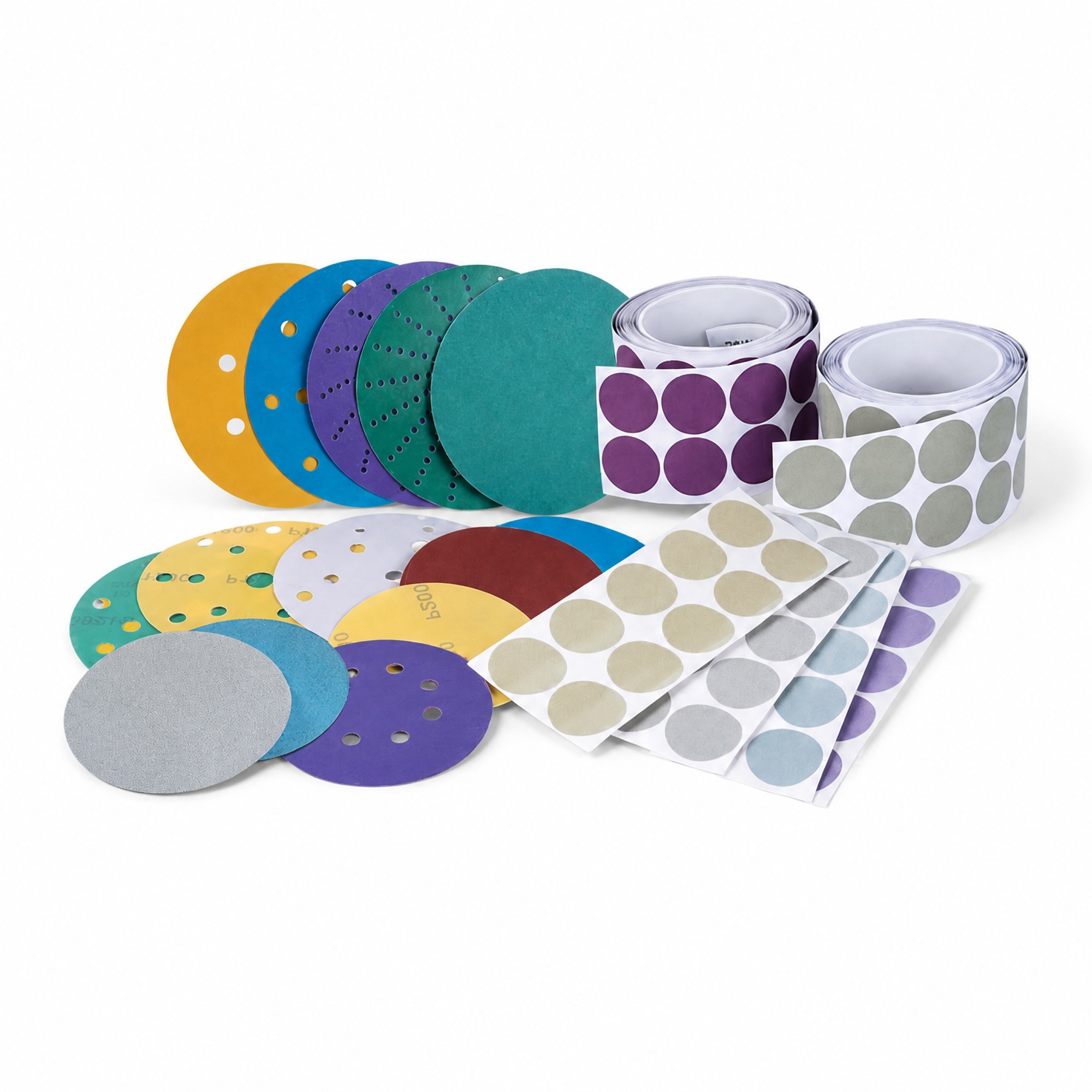
The payoff rarely sits where people expect. It's not in the gloss of a final coat or the mirror shine on a showpiece. It's in the quiet removal of bottlenecks—fewer rework loops, less time spent hand-sanding edges that the automated line already smoothed, and a noticeable drop in the number of parts that get pulled for inspection and never come back.
On the floor, that shows up as a line that keeps moving after lunch instead of stalling. Operators stop compensating for inconsistent roughness with extra passes. The real gain is predictable: a batch that meets spec the first time, without someone hovering over the bath chemistry or guessing at dwell times.
Financially, the gains hide in places like reduced abrasive consumption, lower reject rates that don't trigger a customer audit, and the ability to take on tighter-tolerance work without adding a second shift. That's where surface finishing stops being a cost center and starts behaving like a margin builder.
Matching Grit, Backing, and Bond to the Job
Every role asks for a different blend of persistence, support, and connection, and the trick is knowing which lever matters most right now. A frontline sales job might reward raw grit more than quiet reflection, while a research position leans harder on institutional backing and a tight bond with a few trusted peers. Instead of treating these three as fixed traits, look at them as dials you can tune to the specific rhythms of the work.
Start by mapping the daily friction points. Where does the job stall, and what gets it moving again? If rejections pile up, grit needs to be paired with a support system that helps you reset quickly. If decisions hinge on shared knowledge, strengthen the bond with colleagues who fill your blind spots. The goal isn’t to display all three equally—it’s to match their intensity to what the job actually consumes.
Five Questions to Ask Before Ordering Custom Film Sandpaper
Ordering custom film sandpaper often feels straightforward until the first batch arrives and the grit spacing or backing thickness is slightly off. Before you finalize anything, ask whether the abrasive grain will stay bonded under wet conditions and how the film handles repeated flexing around curved profiles. A supplier should be able to tell you the exact polyester film weight, resin system, and whether the coating is open or closed coat—not just recite a grit number.
Another overlooked detail is roll width and slitting tolerance. If your process feeds sheets automatically, a half-millimeter variance can cause jams or misalignment. Push for real tolerance data, sample strips from the current production line, and a clear answer on lead time for reorders. That way you avoid guessing whether the next shipment will match the first.
Common Pitfalls That Waste Time and Abrasive
Rushing into a surface without a clear finish target usually means repeating the same motion far too many times. You move from a coarse grit to a finer one, spot a few deep scratches that never left, and drop back down to fix them. That back-and-forth quietly eats an afternoon and leaves the material with more visible texture than when you started.
Holding onto a worn disc or belt is another quiet time sink. The abrasive stops cutting, the surface heats up, and you lean into the tool to force progress. What you get instead are uneven patches and scorch marks that send you back to a much rougher stage, doubling the work just to undo the damage.
Then there is the habit of skipping cleanup between grits. Leftover particles from a previous step get caught under a finer abrasive and carve fresh grooves while you try to smooth things out. The motion feels productive, but you are mostly dragging old grit across the surface and creating new scratches rather than removing the old ones.
Reading a Supplier’s Spec Sheet Without Guesswork
Most spec sheets bury the real performance data under a pile of marketing adjectives. Start by ignoring every claim that lacks a number, unit, or test condition. If a sheet says "high efficiency" without stating the load percentage or temperature at which it was measured, that's a red flag. Pull out the actual curves—efficiency vs. load, dropout voltage vs. current, capacitance vs. bias—and read them against your worst-case operating point, not the supplier's typical value. A 95% efficient converter at half load might drop to 80% at the edge of your input range, and the sheet usually won't volunteer that.
Cross-check the fine print under "notes" and "test conditions." Many parameter tables are populated at 25°C, with a single line noting that performance degrades dramatically at temperature extremes. If you're designing for an enclosure that runs hot, derate every thermal figure by at least 20% unless the supplier provides a full temperature derating curve. Also watch for pins or functions that are labeled "no connection" but are internally bonded—probing them can reveal undocumented behavior that changes your layout or noise margin.
Finally, don't trust a single revision of the sheet. Suppliers frequently update maximum ratings, package dimensions, and even logic polarity without a prominent change flag. Pull the latest version from the manufacturer's site, compare it line by line against the one you have, and check the date code on any samples you actually received. A mismatched date code often means you're testing an older silicon revision while the sheet describes a newer one—or vice versa. That kind of silent mismatch has derailed more prototype schedules than any obvious typo ever could.
FAQ
OEM film sandpaper uses a polyester film backing instead of paper. That makes it far more tear-resistant, waterproof, and uniform in thickness. The OEM part simply means it's manufactured for private labels or equipment makers, so you get the same professional-grade abrasive without paying for a brand name.
Film doesn't absorb water, so it won't soften, curl, or fall apart when soaked. It also flexes around contours without creasing and resists loading, which means the grit keeps cutting longer. You end up with a more consistent scratch pattern and fewer sheet changes.
Automotive paint correction is the obvious one, especially for color sanding clear coat. It's also great for metal finishing, composite work, woodworking between coats, and any job where you need a very fine, uniform finish and the abrasive has to survive repeated rinsing.
Start around P800 or P1000 to level orange peel or remove dust nibs, then move to P1500, P2000, and P3000. After that you can go straight to a compound and polish. The film backing prevents deep stray scratches, so the progression can be shorter than with paper.
Check the backing thickness, typically 3 mil or 5 mil, and confirm the abrasive coating is even with no bare spots. Ask about grit consistency against FEPA or ANSI standards, adhesive quality for hook-and-loop discs, and whether they can do custom widths or perforation patterns for your specific tools.
If you're wet sanding or working for more than a few minutes, yes. Paper tears and loads up quickly, while film can be rinsed and reused several times. The higher upfront cost usually pays for itself in fewer sheet changes and a better final surface.
Plenty of film discs are designed for machine use. The backing flexes without cracking, so it holds up to orbital action. Just make sure you match the hole pattern to your sander's pad and use a soft interface pad if you're doing fine finishing work.
Conclusion
When shops move from paper-backed abrasives to OEM film sandpaper, the difference shows up quickly in edge wear and tear resistance. Film backing won’t crack or fold under hard pressure, so operators can sand corners, contours, and narrow radii without the sheet disintegrating mid-stroke. That durability translates directly into lower abrasive consumption and less downtime spent swapping discs or strips. In surface finishing work—whether prepping automotive body panels, deburring machined parts, or refining wood coatings—film sandpaper holds its grit longer and delivers a more consistent scratch pattern. The real gain isn’t just a longer-lasting sheet; it’s the repeatability of finish on high-touch surfaces where rework costs pile up fast.
Selecting the right combination means looking past grit number alone. Match the backing thickness and bond type to the job: flexible film for hand sanding contoured profiles, stiffer film for flat machine platens, and resin-over-resin bonds when heat and loading are concerns. Before ordering custom rolls or discs, ask about roll width tolerances, splice frequency, liner release, and whether the supplier can pre-cut shapes to reduce operator handling. Common pitfalls include choosing too fine a grit to hide deep scratches or ignoring backing caliper when switching from paper—both waste time and abrasive. A reliable spec sheet should list backing material, mineral type, grit standard used, coating weight, and total thickness. If those numbers are missing or vague, request samples and run a side-by-side test on your actual workpiece before committing to volume.
Contact Us
Contact Person: Amanda Wang
Email: [email protected]
Tel/WhatsApp: +86-13602569854
Website: https://www.sunabrasives.com.cn