

Export Sinotruk 8X4 Bulk Feed Truck for Efficient Feed Transport
2026-11-17
Bulk feed transport has a way of exposing weak links—long fill times, uneven discharge, or a chassis that struggles once the bins are full. The Sinotruk 8X4 bulk feed truck is built to keep that from happening, combining a stable 8X4 platform with the kind of smooth, high-volume unloading that feed operations rely on. At KANGMU TRUCK, we focus on matching proven heavy-duty chassis to the real demands of feed delivery. Below, we’ll look at the specs and export details that matter once the silo gates open.
Heavy Bulk Feed Payloads With Stable 8X4 Handling
Moving dense feed mixes on rural routes asks more from a chassis than sheer payload numbers. The real workload sits in how weight migrates during cornering, braking, and uneven climbs. An 8X4 layout gives the rear bogie enough footprint to keep vertical loads distributed, while the twin steering axles resist the wander that usually appears when bulk tanks are partially filled. That matters when a load of pellets shifts just enough to unsettle a lighter front end.
The stability gain shows up most in low-speed turns off pavement and on crowned gravel roads. Instead of the front end pushing wide or the frame rolling noticeably, the vehicle settles into the turn with less steering correction. Drivers tend to report less fatigue on repeated farm stops because the truck is not constantly fighting lateral weight transfer. It also means fewer throttle and brake inputs are needed to keep the load quiet.
Payload expectations stay realistic with this configuration. The additional axle hardware does add tare weight, but the trade-off is cleaner load carrying through soft ground and longer suspension life on washboard sections. For operations running mixed ration ingredients or high-density grains, the combination of a deep payload and predictable handling often outweighs a small reduction in theoretical capacity.
Export-Spec Sinotruk Build Quality From Frame to Tank
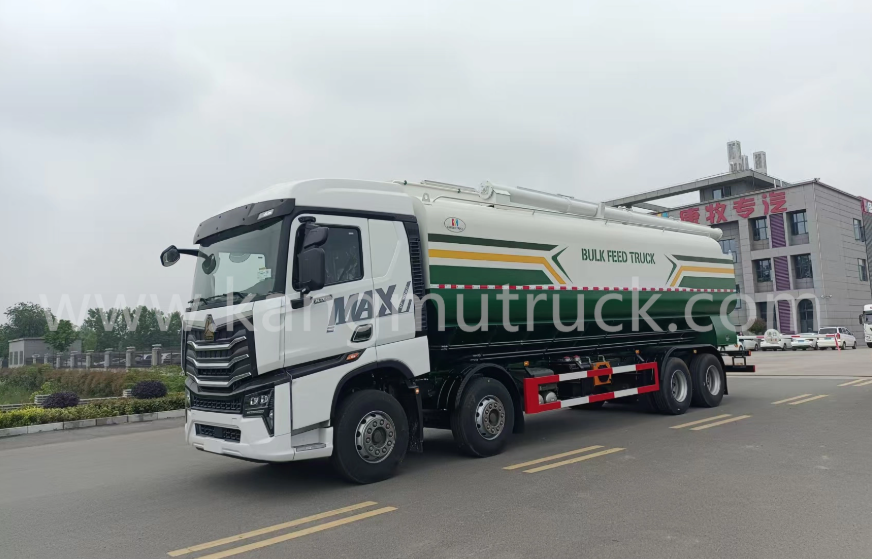
The first thing that stands out on an export-spec Sinotruk is the chassis. The frame rails are cut from noticeably thicker high-tensile plate than some domestic runs, and the crossmember welds have an even, consistent bead with none of the undercut you sometimes see on rushed production. Bolts on the suspension brackets and spring hangers carry torque witness marks, which suggests the assembly line is actually checking rather than just running down fasteners. A black anti-chip coating is sprayed well into the inner channels, not just on visible faces, and the inside of the frame has been cleaned before painting instead of trapping scale and moisture.
That attention continues with the plumbing and wiring. Export units tend to get zinc-nickel or dacromet fasteners instead of plain zinc, which matters once trucks start running through coastal humidity or salted roads in the Middle East and Latin America. Air lines and brake hoses are clipped to the frame at shorter intervals, with nylon sleeves wherever they pass through a crossmember or rub against a bracket. There is still some variation in how neatly the harness is taped at branch points, but the routing is far more disciplined than it was on older chassis. Suspension pins and bushings seat tightly without the sloppy lateral play that used to show up after the first few thousand kilometres.
At the tank end, build quality is more mixed but improving where it counts. The longitudinal welds on alloy and carbon-steel tanks are smooth and uniform, and the internal baffle spacing is adjusted to the product being carried rather than copied from a generic drawing. Tank bodies sit on hardwood or rubber isolation strips over the subframe, which prevents the hard contact points that eventually crack tank shells on rough roads. Manholes, vents and discharge valves are positioned within reach from the ground, and export inspection usually includes a full water-fill and pressure test before the tank leaves the plant. Small things like riveted data plates instead of adhesive labels also hold up better after years of pressure washing and sun exposure.
Feed Delivery Cycles That Spend Less Time Unloading
The difference starts before the truck ever parks. On newer feed delivery units, hopper angles and discharge gate placement are built around gravity instead of manual labor. A steeper cone and a wider, lower outlet let most loads slide out without the driver having to climb up and bang on the sides. That alone can cut unloading time by several minutes per stop.
Hydraulic gates and low-profile cross augers matter just as much. Instead of waiting for a small door to trickle feed onto a conveyor, operators open a full-width gate and let the cross auger move a steady column of feed to the blower or bin auger. The result is a cycle that spends its time moving feed, not standing still while the last half-ton taps its way out.
For farms that run tight morning routes, this changes how many deliveries can be handled. When a truck drops a full load in nine minutes instead of fourteen, the extra minutes come back at every stop across the day. Drivers stay on schedule, bins are full before feeding time, and equipment wears less because there is less idling and fewer starts and stops while product is forced through a bottleneck.
Fuel Economy in Real Feed Hauling Conditions
Feed trucks rarely operate on flat pavement at steady speeds. Their typical day mixes gravel roads, soft ground around bunks, and repeated stops that never let the engine settle into an efficient cruise. That pattern changes fuel use more than the published highway ratings suggest, so judging a truck by a spec-sheet number often misses what happens in the yard and along feed routes.
Weight is only part of the equation. A full mixer or feed body adds rolling resistance and forces more throttle work on hills, but the return trip empty has its own cost because drivers often push harder to keep schedule. Idling during loading, waiting at gates, and running PTOs or augers can burn fuel without covering distance. Over a week, those minutes add up faster than many operators expect.
Small operational changes tend to show up clearly in real hauling numbers. Keeping tire pressures matched to actual load, smoothing throttle inputs on loose surfaces, and limiting idle time while loading have a measurable effect. Route choices also matter: a slightly longer route on firm gravel can use less fuel than a shorter one through mud. In feed hauling, fuel economy is more about handling the conditions than chasing an ideal engine map.
Matching Truck Capacity to Daily Feed Mill Output
Matching trucks to a feed mill's daily output starts with forgetting the weekly average. A mill that runs 500 tons on Monday and 300 on Wednesday needs different hauling capacity on those days, yet many schedules still treat every shift alike. Breaking the day into production windows—bulk load-outs after the morning grind, bagged feed later—makes it easier to see where a small hopper truck is enough and where a larger walking-floor trailer actually pays off.
The most practical approach is to keep a small buffer in daily hauling capacity, around 10 to 15 percent above expected output. That buffer absorbs minor downtime, slow loading, or a customer's late pickup without forcing overtime or leaving finished feed sitting in bins. It is not about running every truck full; it is about having the right number of wheels available when the mill's discharge rate peaks.
On the scheduling side, short-haul deliveries can use smaller straight trucks, while long-distance moves justify larger bulk trailers. This keeps per-ton freight costs lower than forcing one truck size into every route. Revisiting the match every couple of weeks, rather than once a quarter, catches seasonal changes in feed demand before they turn into chronic underloading or missed loads.
Cab Comfort and Visibility on Long Rural Delivery Runs
After the third unmarked gravel turn, the seat cushion stops feeling like an afterthought and starts dictating how the rest of the shift will go. On long rural delivery runs the cab has to absorb hours of patched asphalt, washboard sections, and the occasional one-lane bridge approach. Lumbar support that actually holds its position matters more than horsepower here. Enough seat travel and a steering column that tilts without needing a fight keep shoulders from locking up before the final drop.
Visibility gets tested the moment a driveway disappears behind a treeline or a dog appears from a ditch. Large side mirrors with a clean lower view help place the rear tires on soft shoulders, while a narrow A-pillar and an upright windshield reduce the blind spots that county roads love to hide. Good defroster coverage and wipers that clear the full glass matter just as much when fog settles into the valleys.
Cab layout should feel quiet rather than busy. Switches need to be reachable without leaning forward, and the HVAC vents should clear the side glass instead of only blowing at the driver's knuckles. These details sound minor on a spec sheet, but after twelve hours they decide whether a rural route is manageable or miserable.
FAQ
It is built for loose animal feed such as pelletized feed, grain mixes, and soybean meal. The tank can be divided into separate compartments to keep different feed types or batches from mixing during a single trip.
It uses a hydraulic-driven auger or screw conveyor to move feed from the tank to the discharge point. The operator can control the auger speed and direction from a panel near the rear or from inside the cab, which helps when supplying bins or silos at different heights.
An 8x4 layout provides better weight distribution and stability when carrying bulk feed over rough or long-distance routes. It also allows a larger payload within legal axle load limits compared with smaller configurations, while still handling well on paved roads.
The tank is sealed against moisture and dust, and the interior surfaces are treated to resist corrosion. That reduces contamination and keeps the feed dry. The compartments also prevent shifting and minimize crushing of pellets during transit.
Yes, the heavy-duty frame and reinforced suspension are intended for mixed road conditions, from highways to rural access roads. It can be configured with different tire sets and filtration packages depending on the destination.
It typically comes with a Weichai or Sinotruk engine paired with a manual or automated manual transmission. The exact rating can be matched to the operating area, but configurations around 350 to 400 horsepower are common for this type of work.
Depending on the order, the tank can be built with two to six compartments. More compartments allow a single truck to deliver several feed formulas or serve multiple customers without returning to the mill.
The main points are the hydraulic system, auger bearings, tank seals, and chassis lubrication. Regular checks of the hydraulic oil and cleaning the tank between batches help keep unloading consistent and prevent cross-contamination.
Conclusion
The Sinotruk 8x4 bulk feed truck earns its place on demanding export routes by pairing a heavy-load tank with a chassis layout that keeps the vehicle predictable when farm tracks turn soft. Rather than relying on a single headline figure, the design spreads weight across the four rear axles, so a full load of mash or pellets does not pull the steering axle light or make the rear end wander. The tank and frame are built to export-spec standards, with attention given to welded seams, discharge chutes and protective coatings that hold up after repeated washdowns and long hauls from port to inland feed mills.
In daily operation, the truck fits feed delivery patterns more closely than a generic bulk hauler. The discharge system is set up to move product quickly, reducing the time the vehicle sits at the farm gate; drivers report fewer awkward hose adjustments and less need to reposition on uneven ground. Fuel consumption stays reasonable in real feed-hauling conditions because the powertrain works in a narrow band on rural roads instead of constantly hunting for gears. Capacity can be matched to typical mill output, so a day's production moves in full loads rather than half-empty trips. The cab is also built for long runs, with a raised seating position, glass area that helps spot gateways and overhead wires, and controls placed where a driver can reach them without stretching on rough lanes.
Contact Us
Contact Person: Shen Zhikang
Email: [email protected]
Tel/WhatsApp: 8613908668969
Website: https://www.kangmutruck.com/