

Export Sand and Gravel Separator Chute for Global Construction Projects
2026-11-16
Every construction site that handles sand and gravel faces the same bottleneck: moving material fast without clogging or wearing out the line. When that line stretches from a quarry in Southeast Asia to a high-rise foundation in Dubai, the chute you choose isn't a minor part—it's the difference between on-time pours and costly downtime. At Sinou, we build sand and gravel separator chutes for export that hold up under global project conditions, from coastal humidity to desert heat. This post walks through what to look for before you ship your next unit.
What Overseas Contractors Actually Look for in a Separation Chute
Field engineers rarely talk about separation chutes in terms of elegant design or brochure specs. What they remember is whether the liner lasted through a full crushing season without a midnight patch job. On remote sites in Western Australia or the Atacama, a chute that fails after three weeks isn't a technical issue—it's a logistics nightmare. So the first thing contractors look for is abrasion resistance that matches the actual ore, not the lab sample. They want to know the hardness of the wear plate, the thickness at the impact zone, and whether the manufacturer has seen this specific material before. If the answer is a generic 'our chutes handle all aggregates,' they'll keep looking.
Beyond wear life, there's a quieter obsession with access. A separation chute that can't be opened, inspected, or swapped out without a crane and two extra boilermakers will quietly drain the maintenance budget. Contractors ask how the liners are fixed—bolted, wedged, or glued—because they've all had the experience of a three-hour liner change turning into a two-day shutdown. They also look at the angle of the intake and the transition plates: steep enough to stop sticky material from hanging up, but not so steep that the impact zone gets hammered unevenly. The best chutes are the ones nobody talks about at the morning meeting, because they simply work.
Finally, there's the unglamorous matter of supplier follow-through. Overseas contractors don't buy a chute; they buy a response time. If a liner cracks in week six, they need to know whether the vendor has a local stockpile, a clear part number system, and a technical person who can read a site photo over WhatsApp. The chute itself might be nearly identical between three manufacturers, but the one who answers the phone on a Sunday afternoon is the one who gets the repeat order. That's what actually shows up on the cost report.
Built to Handle Wet Sand and Heavy Gravel Without Clogging
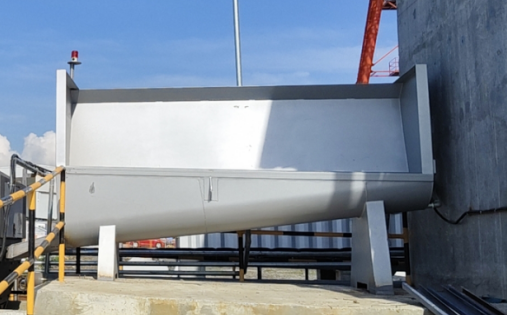
Wet sand and heavy gravel are two of the toughest materials to move without causing downtime. The design skips narrow passages and sharp bends where these mixes usually pack and harden. Instead, every internal surface is shaped to shed material quickly, so even a thick slurry keeps flowing instead of building up around the intake or discharge points.
Where other equipment relies on screens or small clearances, this unit uses a wide-open flow path with hardened wear plates at the points that take the most impact. The impeller or auger profile is deliberately blunt in the centre and tapered at the edges, which creates a rolling action rather than a slicing one. That rolling motion keeps gravel from wedging between moving parts, while the constant turbulence carries finer sand out before it can settle.
In day-to-day use, operators notice the difference within the first few hours. There is no need to stop every shift to scrape out packed material, and the usual rumbling from stones bouncing off a clogged housing is absent. Because the build-up points are minimised from the start, the machine handles full loads of wet, heavy aggregate without slowing down, even when the feed contains a mix of fine sediment and larger stones.
Why On-Site Adjustability Matters More Than You'd Expect
Most people assume a product either fits or it doesn't, and that's the end of it. But the reality is that real-world conditions rarely match the perfect measurements on a spec sheet. Floors settle, walls shift, and the exact angle you planned for is often off by a few degrees. On-site adjustability lets you adapt to those small, inevitable surprises without needing to send anything back or start over from scratch. It's the difference between a solution that works on paper and one that holds up in your actual space.
There's also a hidden cost to rigidity: time. Every trip back to the workshop or another online order adds days to a project that could have been finished in an afternoon. When you can tweak height, depth, or alignment where it's installed, you stop treating the product like a fragile artifact and more like a tool that's meant to be dialed in. That flexibility lowers frustration, reduces waste, and lets you solve problems the moment they appear rather than documenting them for later.
Beyond convenience, adjustability tends to extend the usable life of whatever you're working with. Needs change, spaces get repurposed, and components wear unevenly. If you can make on-the-fly corrections, you're not locked into the original configuration forever. It's a quiet kind of durability that doesn't show up in a product photo but makes all the difference on a busy site.
The Export Packaging Details That Prevent Transit Damage
Many exporters underestimate how much movement happens inside a carton during ocean or road transit. Using loose fill peanuts or crumpled paper alone rarely works once the box gets stacked under heavier cargo. A better approach is to line the base with a high-density foam sheet, place the product in a custom-cut cavity, and then add inflatable air pillows only in the voids that remain after the item settles. For heavier components, bolting them to a plywood base inside the crate prevents the slow grinding that wears through standard cardboard.
The outer shell matters just as much as the inner cushioning. Single-wall corrugated boxes often collapse when humidity softens the glue or when a forklift clamp squeezes the sides. Swapping to double-wall board with reinforced corner posts adds real resistance. Wrapping individual cartons in a moisture barrier film or placing silica gel packs inside sealed poly bags handles condensation that builds up when containers pass through temperature swings. On pallets, interlocking the box layers and using edge protectors under the strapping keeps the load from shifting without crushing the top tier.
How a Well-Designed Chute Cuts Downtime on Remote Job Sites
On remote job sites, every hour of lost productivity carries a heavier price than in more accessible locations. A well-designed chute might seem like a minor component, but its impact on uptime is disproportionate. When material flow is uninterrupted and spillage is controlled, crews spend less time clearing jams and more time on the actual work. Poorly shaped or undersized chutes, by contrast, create bottlenecks that ripple through the entire operation, forcing unscheduled stops that are costly and difficult to recover from far from supply chains.
The key lies in matching the chute geometry to the specific material and discharge rate. Abrupt angle changes or insufficient slope can cause bridging and blockages, especially with damp or sticky materials common on remote sites. A carefully engineered chute with smooth transitions, adequate cross-sectional area, and wear-resistant liners reduces the need for manual intervention. This means fewer personnel exposed to hazardous clearing tasks and fewer replacement parts waiting on delayed deliveries. Downtime becomes predictable and scheduled, not reactive.
Ultimately, investing in a proper chute design pays for itself by preserving the rhythm of the job. When equipment runs consistently, maintenance can be planned around production rather than interrupting it. Remote sites thrive on reliability, and a chute that quietly does its job keeps the whole operation moving without drawing attention to itself.
Matching Chute Angle and Liner Material to Local Aggregate Types
Local aggregate rarely behaves like the idealized material in design charts. Angular crushed granite wears a chute differently than rounded river gravel, and even the same nominal rock type can change from one pit to the next. Before settling on an angle, measure the actual angle of repose, moisture content, and particle shape with a representative sample. A chute that works at 38 degrees for dry, washed gravel may build up at 42 degrees when the same gravel arrives damp and mixed with fines. Instead of copying a generic layout, adjust the slope until the material slides as a continuous sheet rather than tumbling or sticking.
Liner choice follows the local abrasive signature. High-silica crushed rock quickly scours mild steel, so ceramic or chrome-carbide overlays make sense on impact zones and high-velocity transfer points. Rounded, softer aggregates often allow AR400 or even a thick polyurethane sheet, which also cuts down on noise. For sticky limestone or clay-bearing blends, the priority shifts to low-friction liners such as UHMWPE or PTFE-backed plates, combined with a slightly steeper chute angle to prevent buildup. Pay attention to the transition between liner types: a hard ceramic plate next to a flexible polyurethane section can create a ledge if the thicknesses are not stepped carefully.
Field tuning remains the only reliable way to match both variables. Start with a chute angle slightly above the measured angle of repose, then adjust in two- or three-degree increments while running the actual aggregate blend. Listen for the sound of sliding versus impact, and check wear patterns after the first few hundred tonnes. A well-matched set often looks modest on paper but lasts significantly longer and reduces spillage, simply because the angle and liner material reflect what the local rock actually does instead of what a catalog assumes it should do.
FAQ
The chute is a good fit wherever sand and gravel arrive mixed and need to be split before use. Common examples include ready-mix plants, road base operations, and drainage projects. Placing the chute at the truck dump point means the material gets sorted immediately, so there is less loader work later.
Wet material doesn't usually cause trouble because the chute has a steady slope and alternating baffle heights that keep the load moving. For clay-heavy feedstock, an optional spray bar can be mounted above the screen surface to wash the aggregate as it slides, which prevents sticky build-up.
The frame has several pre-drilled mounting positions, so the angle can be adjusted depending on moisture content and feed speed. Screen panels are not welded in place; you can swap between mesh sizes roughly from 5 mm to 40 mm without special tools.
The standard build includes hot-dip galvanized steel for the frame and stainless steel for the screen panels. If the site is near salt water or very humid, we also offer an additional epoxy coating on all steel parts, which cuts down on repainting and replacement.
A typical 6-meter section weighs about 1,100 kg. Several sections can be nested inside a 20-foot open-top container, while legs and guards go into separate crates. That keeps the total under standard container weight limits and reduces freight cost.
No welding or heavy crane is required. The parts are bolted together, and a telehandler or small crane can lift sections into place. Most installations are done in about four to five hours with three workers.
For smaller jobs, the chute's advantage is that it uses no electricity and has few moving parts, so maintenance is low and operating cost is almost nothing. It cannot match the throughput of a large vibrating screen, but up to roughly 150 tonnes per day, it handles the workload with much less fuss.
Wear parts like polyurethane panels and rubber skirting are usually kept in stock. They can be shipped with the original order or sent later by air freight. Each shipment includes a labelled parts diagram so the site manager can reorder exact components without guesswork.
Conclusion
Overseas contractors evaluating a separation chute don't start with the spec sheet; they start with the mess. Wet sand packs, heavy gravel abrades, and a chute that can't be adjusted on the fly becomes a bottleneck. The real requirement is a design that sheds sticky material without constant scraping, and lets a single operator change the angle or flow split without calling for a welder. On remote job sites, that adjustability translates directly into fewer hours lost to clearing blockages or waiting for spare parts. A chute built with replaceable, locally available liner materials—whether polyurethane, rubber, or AR steel—keeps running where supply chains are thin. Matching the chute's slope to the local aggregate's moisture and gradation isn't a nice-to-have; it's what separates a machine that works on day one from one that needs endless tweaking.
Export packaging is where many otherwise good chutes fail before they ever touch aggregate. Bolted connections loosen, painted surfaces rust, and welded gussets crack when a container gets dropped or shifted at sea. Smart exporters brace the throat and discharge lip with timber or steel cradles, isolate wear liners from rubbing, and coat all machined surfaces with a heavy rust preventative that survives salt spray. They also pack adjustment hardware and liner bolts in clearly labeled, waterproof boxes inside the crate, so the chute arrives ready to assemble with zero hunting for missing fasteners. That kind of packaging discipline doesn't show up in a brochure, but overseas buyers notice it immediately on the first unboxing. When the chute survives transit intact and can be fine-tuned to local sand and gravel within an hour of landing, downtime on site drops sharply, and the contractor's confidence in the supplier rises with it.
Contact Us
Contact Person: HaiYan
Email: [email protected]
Tel/WhatsApp: +86 18957325588
Website: https://www.senyoubeton.com/