

DC Fuse Supplier Guide: How to Find Trusted Sources for Critical Circuit Protection
2026-08-25
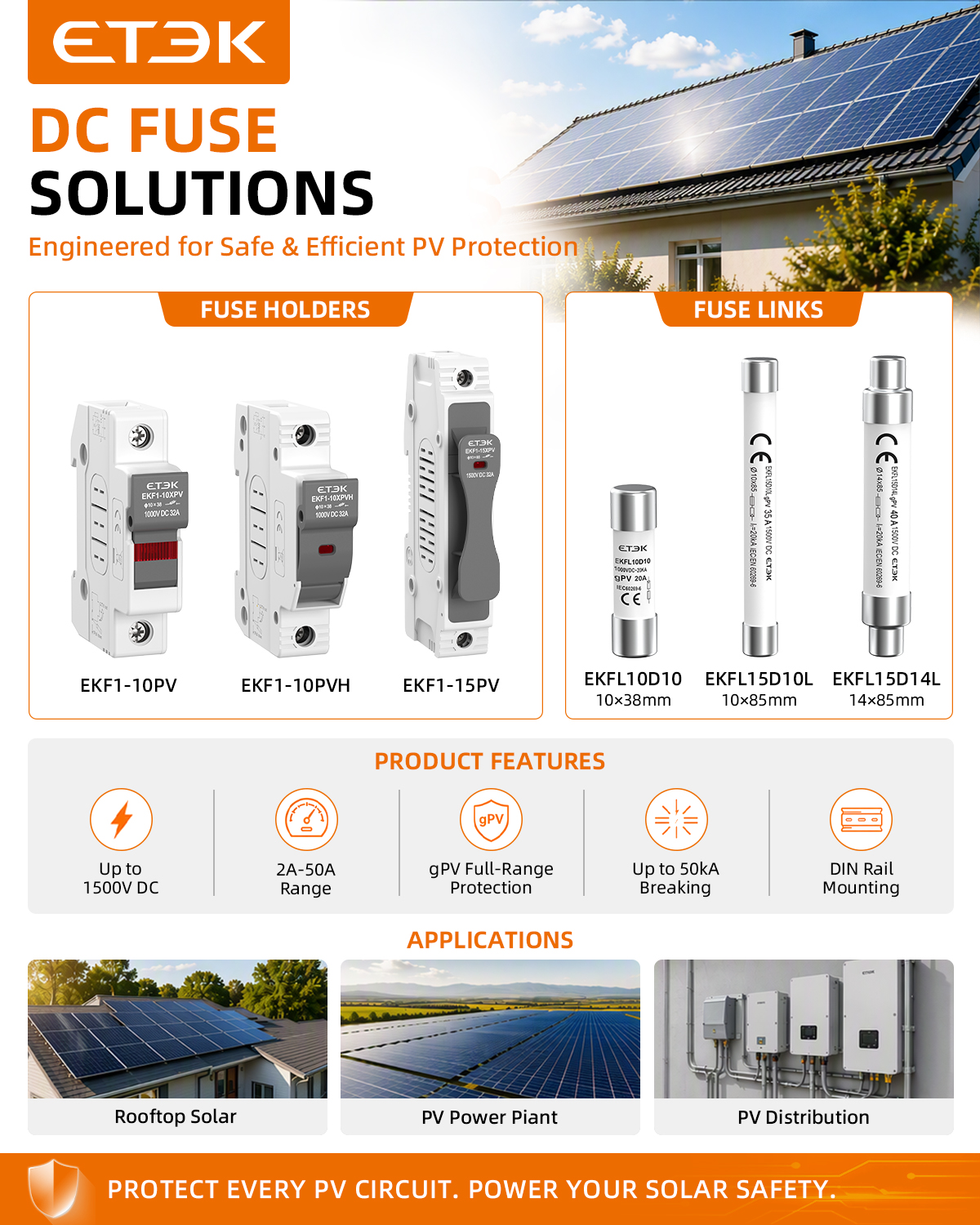
Your circuit protection is only as strong as the fuse supplier behind it—especially when DC loads push every component to its limit. Sourcing the right DC fuse isn't about checking a box; it's about avoiding field failures, downtime, and safety risks that show up when it's too late. In this guide, we cut through the noise around manufacturer claims, certifications, and supply-chain shortcuts, so you can evaluate suppliers with confidence. If you're tired of vague datasheets and unverified specs, you'll find a practical framework here—including how ETEK approaches DC fuse reliability and why it matters for your next design.
The Silent Killers in DC Circuits: Why Fuse Quality Can't Be an Afterthought
A fuse in a DC circuit is not doing the same job as its AC counterpart, yet most designs treat it as a commodity. Direct current doesn't cross zero volts every half-cycle, so when a cheap fuse opens under load, the arc has no natural extinction point. That arc can linger inside the fuse body, vaporizing the element, spattering metal onto the ceramic, and sometimes welding the remaining fragments into a partial short. I've torn down failed DC fuse modules where the sand fill was burned black around a hollow shell— the fuse looked intact from the outside but had quietly become a resistor with a fire inside.
Quality shows up in the details you don't see on a datasheet thumbnail: the grain structure of the fusible element, the purity of the quartz sand used as an arc quencher, the plating on the end caps, and the way the element is welded rather than crimped. In a 48V battery string, a low-quality fuse may pass a 5kA short-circuit test once, then lose its ability to interrupt cleanly on the second or third fault because the sand has fused into glass around the element. That's the silent killer: the fuse isn't dead on arrival, it just gets weaker with every minor overload until it fails to protect anything.
The real cost shows up months later when a battery pack develops a soft short and the "rated" fuse doesn't open until the wiring is already smoking. By then the protection has been downgraded to a thermal event. Buy fuses from vendors who publish DC interrupt ratings at the actual system voltage, not just AC ratings copied across. And treat the fuse as a component you qualify, not a box you tick on a BOM. A few extra cents per unit is cheap insurance against a DC arc that doesn't care about your warranty.
Supplier Claims vs. Load-Bank Reality: Separating Marketing from Performance
A data sheet can list a 1 MW rating, but the real question is whether the load bank holds that figure after three hours of continuous duty. Many suppliers quote maximum capacity in ideal ambient conditions, often at 25°C with unrestricted airflow. On site, inside a container or near a generator exhaust, inlet temperatures climb past 40°C, and derating sets in quickly. The disconnect between marketing numbers and actual sustained performance shows up first in thermal cycling: cheap resistive elements drift, breakers trip earlier than expected, and the control system starts reporting optimistic power factors that do not match the measured draw.
Another gap appears in instrumentation. A load bank may claim 1% accuracy on its meters, but that only matters if the CTs and voltage references are calibrated as a complete system, not just in the factory. After shipping, vibration and humidity shift those readings. The better question to ask a supplier is not what accuracy class the meter carries, but whether they can produce a recent third-party calibration certificate from a test that matches your actual load profile. If they hesitate, the performance claim is usually thinner than the brochure suggests.
Finally, listen for how a manufacturer talks about failure modes. Marketing often focuses on maximum load, sleek enclosures, or remote monitoring apps. Field reality is dominated by contactor chatter, unbalanced phase loading, and hot spots on bus bars. Suppliers who openly discuss derating curves, maintenance access, and step resolution are separating performance from promotion. Those who only repeat peak kilowatts are selling a number, not a test instrument.
Certifications That Count: Decoding UL, IEC, and the Fine Print
Product labels often carry a jumble of acronyms that most buyers skim past. Yet those small marks—UL, IEC, and a host of regional equivalents—tell a deeper story about how a device was tested, under what voltage conditions, and with which safety assumptions baked in. The fine print rarely gets read, but it’s where the real distinctions hide: a UL listing isn’t the same as a UL recognition, and an IEC standard number without a corresponding national adoption leaves room for interpretation.
UL leans heavily on component-level evaluation and ongoing factory audits, which is why a UL mark often carries more weight in North American commercial installations. IEC, by contrast, publishes internationally agreed test methods, but enforcement depends on local bodies—so a product claiming “IEC 60950 compliance” may still face extra scrutiny at the border. The fine print on a datasheet, like “certified to IEC 62368-1 by TÜV” versus “tested in accordance with UL 62368-1,” changes liability, insurance expectations, and even whether an inspector will pass the install.
When comparing seemingly identical power supplies or lighting drivers, the certification list on page three is often what separates a solid design from a gamble. Look past the bold logos. Check for temperature ratings, pollution degree assumptions, and whether the standard referenced is the latest edition or a ten-year-old version still floating around. Smart buyers treat certification text like a contract—because that’s exactly what it is between manufacturer, lab, and the jurisdiction where the product will live.
Vetting the Vet: Questions That Expose a Supplier's Real Expertise
Ask a supplier to walk you through their most recent product failure. Not the polished post-mortem, but the messy first hour after they realized something went wrong. How did they identify the root cause? Did they loop in the customer immediately, or did they try to hide the issue until a fix was ready? A supplier who can't describe the uncomfortable details of a failure—who only talks about successes—probably hasn't been tested in the ways that matter.
Push them on the 'why' behind their material choices. For example, if they use a specific grade of stainless steel, ask what would happen if you swapped it for a cheaper alternative. A true expert won't just recite a spec sheet; they'll explain trade-offs in terms of thermal expansion, corrosion resistance under your exact operating conditions, and how a tiny change could cascade into a field failure six months down the line. Vague answers like 'it's industry standard' are a red flag.
Finally, ask about the last time they told a customer 'no.' A supplier who always says yes to every request—impossible timelines, unrealistic tolerances, last-minute design changes—is either lying or dangerously overconfident. Expertise includes knowing when a request will compromise quality, and having the backbone to push back with data and alternatives. If they can't recall a single instance of saying no, their expertise is probably just salesmanship in disguise.
From Datasheet to Doorstep: How to Spot Counterfeit Fuses Before They Bite
Counterfeit fuses rarely announce themselves with obvious flaws. The first line of defense sits in the paperwork: pull the manufacturer's datasheet and compare every claimed rating—breaking capacity, voltage drop, time-current curve—against the markings on the component. Discrepancies in font weight, logo placement, or even the shade of the body material often surface before any electrical test does. If the datasheet lists a specific date code format or a laser-etched traceability mark, missing or blurred marks are a clear red flag.
Once the fuse arrives, don't just trust the box. Check the packaging for tampering, mismatched lot numbers, or reused reels. A genuine fuse from a reputable brand will have consistent lead spacing, clean end caps, and no signs of re-tinning on the terminals. Under magnification, counterfeit parts frequently show uneven plating, scratches from prior removal, or a slightly different body length—details that never appear in datasheet photos but matter when the part heats up under load.
The real test happens before installation. Run a small-sample verification: measure cold resistance, compare the melting integral at a known current, or subject one fuse to an intentional overload while watching the clearing time. Counterfeits often use thinner or incorrect wire alloys, so a slow-blow fuse might open instantly—or worse, fail to open at all. Catching that at the bench is far cheaper than learning about it on a production line or in the field.
When Your Circuit Protection Fails at 3 a.m.: What a Good Supplier Does Differently
At 3 a.m. your breaker trips, an arc flash sensor screams, and your production line grinds to a halt. A generic supplier's response is voicemail followed by a call-back sometime after breakfast. A good supplier doesn't just answer the phone—they already know which panel you're talking about. Their support engineer pulls up your one-line diagram, cross-references the serial number you mumble half-awake, and starts walking you through a remote diagnostic before you've finished your first cup of cold coffee.
That same night, a good supplier has a local service partner dispatched with a replacement trip unit pulled from a regional stock that mirrors your exact breaker family, not just a 'compatible' substitute. They don't ask you to fill out a return authorization form while your downtime stacks up; they ship the part first and handle the paperwork later. Their entire inventory system was designed around midnight failures—critical spares tagged with failure-history data so the replacement's firmware is already matched to your protection settings from the last commissioning report.
By the time your maintenance crew arrives at 5 a.m., the supplier's field tech is on site with the replacement installed, a root-cause summary typed into a shared portal, and a list of three other breakers in your plant that have the same vintage and might be next. That's not luck. It's a supplier that treats circuit protection as a service contract with your uptime, not just a catalog number. The difference isn't just a faster truck—it's an organization built so that 3 a.m. doesn't become a crisis, just an inconvenient alarm clock.
FAQ
Look beyond the catalog. A dependable supplier will ask about your interrupting rating, time-current curves, and environmental conditions before recommending anything. They should be able to provide test reports from UL, IEC, or TUV for the exact fuse part number, not just a generic certificate. If they can't explain how their product behaves under short-circuit conditions, walk away.
Ask for the certificate number and verify it directly on the certifying body's database. Many suppliers show a logo on a datasheet, but that's meaningless without a valid file number. For DC applications, check if the certification covers the DC voltage rating you need, because AC approval doesn't automatically extend to DC.
They choose a fuse based only on current rating and ignore the DC voltage rating and interrupting capacity. A fuse that works at 12V DC may fail dangerously at 500V DC. Another mistake is not accounting for ambient temperature derating — a fuse in a hot battery enclosure will blow earlier than expected. Always match the fuse's breaking capacity to the maximum fault current the system can deliver.
Not for critical protection. Low price often means thinner fuse elements, looser tolerances, or untested materials. The cost of a failed fuse during a short-circuit event is catastrophic compared to the few cents saved per unit. However, you don't need the most expensive option either — demand proof that the design has passed third-party testing and ask for batch consistency data.
Request specific test data for interrupting rating at the system's DC voltage, not just a claim. Ask about the fuse's time-current curve under your actual load profile, including inrush currents from inverters or motor starts. A good supplier will also discuss arc quenching technology and may offer to run a sample test in their lab with your parameters.
It's a huge differentiator. The right supplier will help you model fault current, select the correct fuse class like gPV, aR, or gR, and review your PCB or holder design for thermal management. If they only answer with a part number, you're not getting a partner — you're getting a distributor. Look for engineers who ask about your system's fault loop and ambient environment before quoting.
Buy directly from the manufacturer or an authorized distributor with a documented chain of custody. Inspect incoming batches for poor printing, weight differences, or inconsistent terminal plating. For critical circuits, consider using fuses with unique serialization or lot traceability. A reputable supplier will provide a certificate of conformance with each shipment and won't hesitate to show their manufacturing location.
Sometimes, yes. If your application has unusual inrush profiles, high altitude, or extreme temperatures, standard fuses may not behave as published. A custom test at the supplier's lab using your actual load can reveal nuisance blowing or insufficient clearing time. This is especially valuable in battery energy storage or EV charging where a field failure could be dangerous and expensive.
Conclusion
DC fuses often get treated as commodity parts until a minor overload becomes a charred board. The real danger isn't the fuse that fails loudly; it's the one that drifts, arcs, or opens late enough to take a controller with it. That's why "trusted source" can't mean a seller with a polished landing page. Load-bank testing reveals what datasheets hide: a 20 A fuse that opens at 27 A may pass a quick bench check but kill field equipment over time. Certifications help, but only when you read the actual test conditions. A UL listing for a fuseholder doesn't necessarily cover the fuse itself, and IEC ratings vary by voltage class and breaking capacity. Suppliers who wave a generic certificate without tying it to the exact part number are often selling borrowed credibility. Ask for the specific test report and look for third-party marks that match the fuse's interrupting rating and DC voltage rating, not just an AC number.
Beyond the paperwork, a trustworthy supplier behaves differently under pressure. Ask pointed questions: "What is the DC interrupting rating at 48 V? Can you supply a time-current curve for this batch, not a decade-old scan?" If the answer is a shrug or a promise to check, keep looking. Counterfeit fuses are the uglier cousin of this problem—sand-filled tubes with recycled end caps and undersized elements. A good vendor will show batch-level traceability, including date codes, factory audits, and lead-frame photos. And when a fuse opens at 3 a.m. on a factory floor, the right supplier doesn't just answer the phone; they help pull the failure report, check whether the application exceeded the fuse's let-through energy, and ship a replacement with the same lot data. That's the difference between a parts pusher and an actual circuit-protection partner.
Contact Us
Contact Person: Andy
Email: [email protected]
Tel/WhatsApp: +86 13356133008
Website: https://www.etek-china.com/